Mathematics
Combinatorics
Combinatorics, the branch of mathematics concerned with counting, arrangement, and combination of objects, plays a crucial role in quantitative finance. It provides the mathematical foundation for analyzing various financial models, optimizing portfolios, pricing complex derivatives, and managing risks. This introduction aims to shed light on the key aspects of combinatorics, ending with an introduction on a foundational distribution in the finance space: the binomial distribution.
Combinatorics is the branch of mathematics concerned with counting, arranging and selecting objects. Combinatorics is used in quantitative finance, as we will see when we cover the binomial pricing model, and combinatorics questions come up frequently in technical interviews. The first concept we will outline is combinations. Combinations are a way to choose a subset of items from a larger set, where the order of selection does not matter. Suppose we have $n$ objects. The total number of possible ways of having $k$ distinct combinations of objects from the starting pool of $n$, disregarding order of objects is $$ {n \choose k} = \frac{n!}{(n-k)!k!} $$ $n!$ denotes the factorial of n - the product of all integers from one to $n$ inclusive $$ n! = \prod_{k=1}^{n} k. $$
Example: the Binomial Distribution
Consider an experiment which can either succeed with probability $p$ or fail with probability $1-p$. The binomial distribution is a discrete probability distribution which gives the probability of $k$ successes in $n$ independent experiments. The probability mass function is $$ f(k,n,p) = P(X=k) = {n \choose k} p^k (1-p)^{n-k}. $$ Notice that the probability mass function includes ${n \choose k}$, that is, the number of ways to distribute $k$ successes in a set of $n$ trials. The expected value of the binomial distribution is $$ \text{E}[X] = np $$ and the variance is $$ \text{Var}(X) = np(1-p). $$
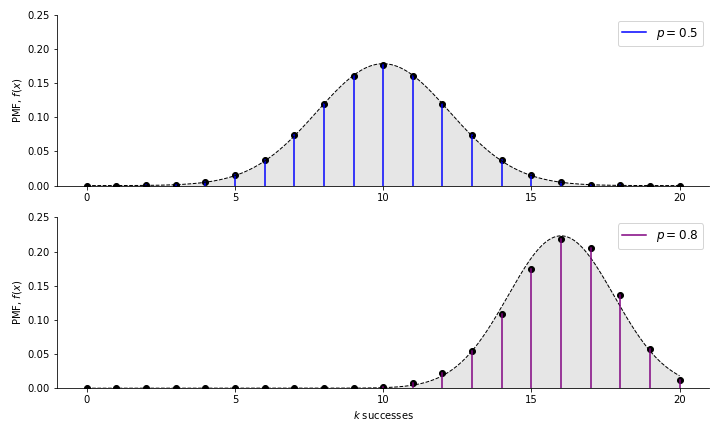
Probability mass function of the binomial distribution
An important property of the binomial distribution is that if $n$ is large and $p$ is not too close to zero or one, then the binomial distribution can be reasonably approximated by a normal distribution with equal mean and variance, that is $$ f(k,n,p) \sim N(np, np(1-p)). $$ We see the figure above that for $n=20, p=0.5$ that the distribution is well approximated by a normal distribution. However, for $p=0.8$ the approximation is less accurate. This approximation enables us to do some remarkable calculations with very little working.